
Warehouses with thousands of SKUs lose picking efficiency as operators spend time searching for items, increasing errors and cycle times.
Manual picking in multi-level storage increases travel time and safety risks, slowing order fulfillment and limiting throughput.
Peak order volumes overwhelm manual picking, causing delays, backlogs, and missed fulfillment SLAs.
Manual aisles and picking zones reduce usable storage space, causing warehouses to hit capacity limits early.
Picking speed and accuracy depend heavily on operator experience, while training and turnover reduce overall performance.
Returns, re-slotting, and frequent SKU changes disrupt picking locations and workflows, increasing mispicks and slowing fulfillment.


Tote-to-Person approach, adapted to different industries, order profiles, and operational constraints.
Built for multi-client operations with unpredictable peaks, fast turnaround times, and frequent SKU changes across accounts. Typical focus: scalability, client isolation, peak resilience.

Handles click-and-collect, D2C, and store replenishment from a shared inventory pool without compromising picking speed or accuracy. Typical focus: orchestration, order prioritization, flexibility

Supports bulk replenishment, tight SLAs, and channel-specific order profiles across wholesale and franchise networks. Typical focus: throughput, reliability, SLA compliance

Fast, zone-based picking across ambient and chilled areas for time-sensitive orders and stable daily volumes. Typical focus: speed, freshness, operational safety

Optimized for high-SKU, low-unit picking with seasonality, returns, and frequent assortment changes. Typical focus: flexibility, accuracy, returns handling

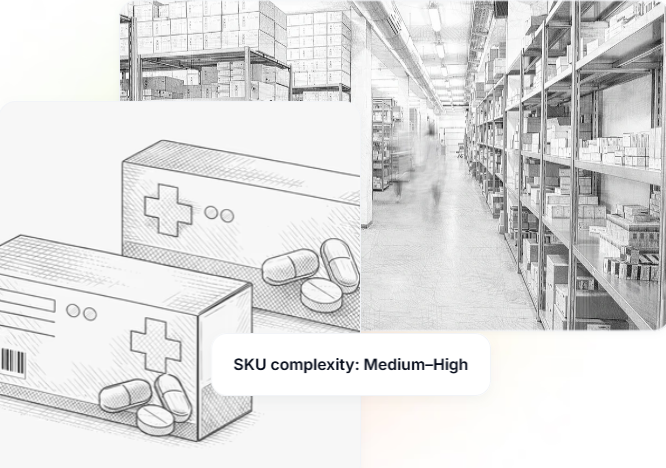
Built for regulated environments requiring high accuracy, traceability, and controlled batch handling. Typical focus: accuracy, traceability, compliance, controlled handling.
Designed for operations where walking distance, SKU growth, or space limits reduce picking efficiency. Typical focus: productivity, space utilization, labor efficiency.

Overcoming Labor Shortages: Even with a small workforce, robots boost warehouse productivity by automating repetitive tasks.
50% Better Space UtilizationAutomated systems enable up to 50% improvement in how warehouse space is used.
Higher Accuracy and Efficiency: The system highlights the correct shelf, reducing errors and the costs associated with fixing them.
Increased Throughput:AI-driven routing optimizes robot movement, ensuring continuous material flow and enabling one worker to process more orders.
Accessible and Scalable:The best price-to-value ratio: fast integration, flexible deployment, and easy reconfiguration of warehouse layouts.